Wednesday, 7 January 2015

The Benefits of Attic Insulation

Many homeowners are not aware of the benefits that proper
attic insulation can have for their homes. Insulating this space can help to
keep your home at a constant temperature, as well as protecting the items that
you put in storage and lowering your utility bills. If you are concerned about
any of these issues, then you should look into insulating this space in your
home as soon as possible.
Keep Your Home at a
Constant Temperature
One immediate benefit that you will see after installing
attic insulation is that your home maintains a constant temperature. Your upper
floors will be much cooler in the summer and warmer in the winter. In fact, the
temperature of your upper floor will be much the same as your ground floor
temperature. This is because you will no longer be losing temperature through
the roof of your house. In the winter, the warm air in your house rises, and
this warm air can be lost if the uppermost floor of your home is un-insulated.
In the summer, on the other hand, the intense heat from the sun can cause your
upper floors to be too warm. Insulating can help to curb this problem, and
create a more pleasant and even temperature throughout the house.
Keep Your Stored
Items Safe from Harsh Temperatures
Another benefit of attic insulation is that it will keep
those items that you store safe from the extreme temperatures of summer and
winter. It is not uncommon for items that get stored in attics to be damaged
over the years due to exposure to extreme temperatures. If you live in a
southern city, it is not uncommon for attics to reach temperatures of one
hundred and twenty degrees or more. This can cause your stored items to sustain
damage and force you to get rid of them. By insulating this space in your home,
you can avoid damage of this kind.
Lower Your Utility
Bills
Finally, attic insulation can help to save you money on your
utility bills. Since an un-insulated space can cause the temperature in your
home to fluctuate, your heating and cooling systems tend to have to work harder
in order to accommodate the change in temperature. This means that your monthly
bills are likely to be much higher than they need to be in the winter and
summer months. By insulating, you can save yourself money during these times,
and this is something that any homeowner would welcome.
Monday, 5 January 2015
Monday, 22 December 2014
Saturday, 20 December 2014
Things to Consider When Installing Attic Insulation
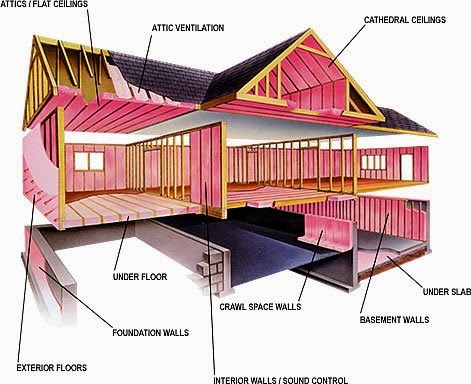
Having the right level of attic insulation in your house is
definitely one of the most important considerations in keeping your energy
costs low. Attic insulation protects from the cold in the winter, and also
keeps the cool in during the hot summer months. What considerations factor in
towards making your attic a well insulated place?
Examine first the type of attic insulation you have. Many
older houses have what is referred to as batt insulation. That's the kind that
comes in large rolls, and is typically colored pink or yellow. The insulation
is spread out in the attic, generally between the wooden beams. The other kind
of insulation is called blow-in insulation. Blow-in insulation is typically
installed by professional contractors, as they have the correct equipment to do
the work. Small bits of insulation are mechanically wind blown into the attic,
creating the blanket across the attic floor. You will generally find this kind
of insulation in new houses.
There are of course good and bad with either batt insulation
or blow-in insulation. Batt insulation, when installed properly provides an
equal R-Factor through the attic. The R-factor is the measurement of the
overall performance of the insulation, and is also called the thermal
performance. It measures the resistance of the flow of heat. Batt attic
insulation that is properly installed will give you a uniform R-Factor through
the entire attic.
Alternatively, blow-in insulation is propelled into the
attic with a machine. While it is very difficult to blow it in uniformly
through the whole attic, the result is a variable R-factor in that space. As
long as the installation is done thoroughly, and the necessary minimum number
of inches sits on the flooring of the attic, the insulation will do the trick.
This makes the issue of a non-uniform R-factor a non-factor overall.
The money involved with batt and blow-in insulation is of
course another factor to consider. Usually batt insulation costs less to buy,
but your time is something to consider as well. Lots of time is needed to
correctly add insulation, or replace the existing insulation.
When adding attic insulation, you of course have to have the
right equipment, including proper clothes, lots of time, and plenty of
patience. Alternatively, you can always contract the job out for a little more
money, and have a blow-in insulation job completed in just a few hours without
as much trouble.
Friday, 5 December 2014
Home Insulation and What You Need to Know

Home insulation is important for houses in this age of high
energy cost. Home insulation helps to reduce the cost of utility bill in terms
of low energy usage. Moreover, it also boosts the values and livability of
houses. Therefore, home insulation is especially a must for houses that are
more than 10 to 15 years old which tend to be not insulated when they were
built 10 to 20 years ago. Even if they were insulated at that time of
construction, the insulation technology or the material might not be as good as
today's technology. Therefore, it's better for you to replace or remodel the
insulation if they were installed a decade ago.
The first step to installing home insulation is to identify
areas of the house that need to be insulated. The general guideline here is to
look at places where there is contact or leak between the interior of your
house and the outside world. A good example of this scenario will be the
window. During the winter, when you open the window, you can feel the cold air
from outside tends to rush into the house. It's the same in the summer where
the heat will enter the house once the window is open. When this situation
happens, heat loss or heat gain is occurring.
One thing to remember is that heat exchange is not
restricted to just the window and the door. It also happens at places that are
intact such as the wall, ceiling and the roof. Even though the wall, ceiling
and the roof is a poor conductor, heat loss and heat gain will still occur. If
there is a crack in the wall or a hole in the ceiling, heat loss or gain will
be accelerated at a faster rate. Therefore, we need insulation to reduce or
better eliminate completely the rate of heat loss and gain. With that being
said, areas such as the walls, ceiling, basement, attic and the roofs are the
critical areas that require to be insulated.

Once you have determined the insulation areas, next step is
to choose the insulation material and types of insulation. Some common
insulation materials that are affordable to most households are fiberglass,
wool, paper, wood and cotton. The more expensive material is the popular
polyurethane that is used in spray foam insulation. The polyurethane can cost
up to several times more than the conventional materials such as fiberglass,
wool and cotton. New and non-conventional insulation materials are being
developed constantly in the market.
Insulation Material Manufacturer
Insulation Material Manufacturer
Home Insulation Guide - Calculate How Much Insulation You Need

Home insulation process is applicable for converting any
areas of your home resistant to heat loss. Whether it is attic, floors, windows
and doors or floors of the house is catalyst to heat loss, seal the draughts
with appropriate insulation methods. Even when you are using air conditioning
appliances, costly and artificially conditioned air will be lost due to lack of
insulation in your house. Insulation when added in right proportion retards
natural tendency heat to move from warmer place to cooler region leaving and
also entry of cold air into the house. Similarly, properly insulated house
keeps the scorching heat off the house. The amount of insulation needed by your
property differs from one property to another and also depends on the climate.
Do you know how much home insulation your house needs?
Measurement of Home
Insulation
One needs to decide what type of insulation and in what
proportion it is needed. The best possible way to know that is by calling
utility professionals who provides information through "energy
audit". They take complete assessment on availability of draughts in the
house and the area should be sealed with insulation treatment. Efficacy of any
type of insulation is measured through R-value or resistance value of the
material used in insulation. Home insulation materials vary in their R-value or
heat resistance provided by every inch of thickness.

The R-value tends to differ in different climate and the
pattern in which the building is constructed. In the mild climate, the right
proportion for wall insulation and floor insulation should be R-11 while for
attic insulation it should be R-19. Likewise, in moderate climate regions, R-19
is the right amount of insulation for floors and walls and R-30 is appropriate
for roof. Buildings in the colder climate regions require wall insulation and
floor insulation of R-19, about R-38 to 49 for ceilings area.
To calculate the required amount of home insulation on the
existing layer of insulation, first of all you need to switch off the
electricity of the house. You should also unscrew electrical outlet cover and
place a hanger in the open space. Use hanger to measure depth available to lay
the insulation to that space. At the same time, see what kind of insulation is
added to the area by removing some insulation using the hanger. You can also
call for an insulation survey company or professional to inspect and give you
detailed assessment of the insulation you have and require.
Subscribe to:
Posts (Atom)